

Raven's Dispatch: Weekly Pagan & Norse Community News
Photo courtesy North Jutland Museums, via Medievalists.net.
Week of October 18–25, 2026
Old gold, old stones, and a new round of arguments over who gets to define a religion. This week’s dispatch follows the evidence where it leads, from a Danish hoard destined for a museum case to living communities pushing back against exclusion. We’ve also got a skywatching window, upcoming gatherings, and a few dates worth putting on the calendar.
FRONT PAGE: Six gold rings, one remarkable find
A local resident walking beside a field path near Rold, in northern Jutland, spotted two gold arm-rings partly exposed in the ground. No metal detector. Just sharp eyes, and a find brought to Nordjyske Museer as danefæ, Denmark’s legal designation for archaeological treasure.
A follow-up detector survey turned up a third ring near the first two, then three more about 15 metres away. The six intact rings weigh 762.5 grams altogether. They form Denmark’s third-largest Viking Age gold find, after the Tissø Ring, found in 1977, and the Fæsted Hoard, found in 2016.
The rings aren’t all alike. Three are twisted from pairs of gold rods; one combines thin gold wire with a knob-shaped closure. The other three are smooth rings made from solid rods or wire. Wrapped closures, zigzag lines and triangles add detail. None has been cut or broken into pieces: a difference Nordjyske Museer says supports interpreting them as symbols of wealth, rank and affiliation, or as high-status gifts, rather than bullion meant to be divided by weight.
The dating has two levels of precision: Nordjyske Museer places the hoard roughly between 900 and 1000; the National Museum of Denmark gives the second half of the 10th century. That was a period of political and religious change. Around 965, Harald Bluetooth proclaimed on the great Jelling Stone that he had won all Denmark and Norway and made the Danes Christian. Nordjyske Museer suggests the ring owners may have had ties to the developing Danish monarchy.
Torben Sarauw, head of cultural heritage at Nordjyske Museer, called it “a completely unique find.” He said rings deposited together may have been hidden to protect valuables in troubled times, or placed as part of rituals whose meaning is difficult to determine now. Kirstine Pommergaard of the National Museum offered another possibility: a religious act deliberately taking valuable objects out of circulation. We don’t know which explanation is right.
Sidsel Wåhlin, archaeologist and curator at Vesthimmerlands Museum, points to a similar arm-ring from Aggersborg, near the Limfjord, where a huge magnate’s hall stood before the Viking ring fortress. “You don’t get that much wealth without being internationally connected,” she said. The six rings are on temporary display at the National Museum in Copenhagen until the end of December. The discovery site is private land with no public access; the finder and landowner remain anonymous.
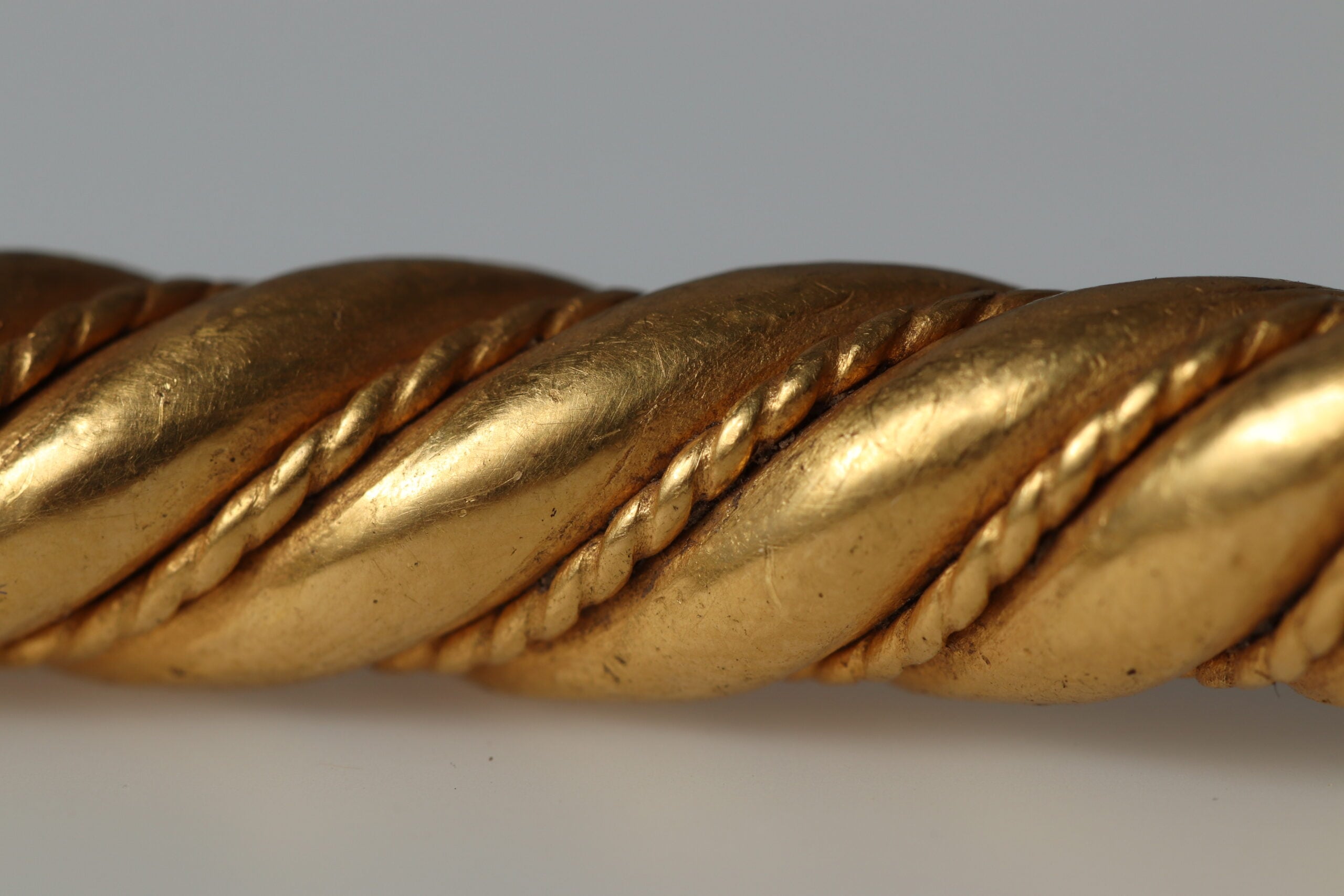
Photo courtesy North Jutland Museums, via Medievalists.net.
ARCHAEOLOGY DESK: Runestones get a closer look
A new Danish research project will put 3D scanning to work on many of the country’s roughly 260 known runestones. Announced October 8, Hugget i granit: Runesten som epigrafisk praksis 600-1100 (“Carved in Granite”) is scheduled to run from 2027 to 2031, with DKK 4.2 million in funding from the Augustinus Foundation.
Researchers plan to study chisel marks, hammer strikes and groove spacing. Details that may help identify individual runecarvers, much as handwriting can identify a writer. They’ll also use geophysical surveys to investigate where stones originally stood. Most have been moved, and their first settings may have been beside trade routes, farms or burial monuments that no longer survive.
The project will also examine inscriptions as possible legal, religious and political documents, including questions about property rights and whether Christianisation changed practices around land donated to the Church. A 2023 study used scanning and linguistic analysis to identify Ravnunge-Tue as the carver of the larger Jelling Stone and a monument at Læborg, findings that suggested Queen Thyra may have held a larger role in early Denmark than previously recognised. Runestones, as National Museum researcher Lisbeth Imer put it, “float around in the sea of history like solitary icebergs.” This project aims to find more of the surrounding landscape.

Image: Nationalmuseet, via NordiskPost.
ARCHAEOLOGY DESK: Herlaugshaugen’s ship burial confirmed
A peer-reviewed paper published in Antiquity this spring confirms ship remains at Herlaugshaugen, one of Norway’s largest burial mounds, on the island of Leka. An excavation in June 2023 recovered 29 iron clinker nails, with wood fragments, used to join a ship’s hull planks. Radiocarbon dating places the burial around AD 700.
That makes it one of Scandinavia’s earliest known ship burials, roughly a century older than other Scandinavian examples and a chronological link between English burials such as Sutton Hoo (AD 600–625) and later Scandinavian Viking Age burials, from AD 800 onward. Leka lies far north of most known ship burials; researchers read it as a node in a wider trade network connecting northern and southern Scandinavia.
One point needs a clean line: the mound appears in Snorri Sturluson’s 13th-century saga as the grave of the semi-legendary King Herlaug, but the radiocarbon date places this burial generations before the Viking Age proper. The saga attribution doesn’t fit the dating.

Photo: Freia Beer, NTNU University Museum, via Antiquity.
COMMUNITY DESK: Inclusion, advocacy and a museum milestone
Declaration 127 3.0: On October 3, the Troth’s High Rede approved a revised inclusivity and anti-discrimination statement developed by its Community Relations Committee. The Troth took stewardship of the original anti-racist declaration in April 2024; a subcommittee spent two years revising it. The new version calls for active resistance to discrimination, including racism, transphobia, ableism and gatekeeping over who may worship which deities or practice in which ways. That dispute is real within Heathenry, where some groups exclude people based on ancestry or choice of gods.
Pagan Federation speaks out: In an October 10 statement, “Standing Together Against Religious Intolerance,” the UK Pagan Federation responded to incidents including an Evangelical Alliance UK guide framing Witchcraft, tarot and astrology as spiritually dangerous and interest in alternative spirituality as an opening for evangelism. “We do not believe that any pathway is ‘better’ than the other,” the Federation wrote. It also pointed members to advocacy assistance, safeguarding resources and pastoral support.
Buckland Museum turns 60: The Buckland Museum of Witchcraft and Magick in Cleveland marks its 60th anniversary this year. Founded in 1966 by Raymond Buckland, who helped introduce Gardnerian Wicca to the United States, the museum began in his Long Island home, reopened in Cleveland in 2017 and moved to its current Old Brooklyn location in 2019. Owner Toni Rotonda and executive director Steven Intermill emphasize education and countering stereotypes. The anniversary coincides with the memoir Keeping the Circle: The Story of the Buckland Museum of Witchcraft and Magick.
LEGAL & CIVIC DESK: A proposed execution livestream draws criticism
The Pentagon has confirmed plans to livestream the December 3 federal execution of Nidal Malik Hasan, the former Army psychiatrist convicted of killing 13 people and wounding dozens in the 2009 Fort Hood shooting. Hasan is scheduled to die by firing squad. If carried out, it would be the first government livestream of an execution in American history.
Damien Echols, Pagan author, ceremonial magician and former West Memphis Three death-row inmate, criticized the plan to Newsweek. Broadcasting it, he said, would be “detrimental to the mental, emotional and spiritual health of society and civilization.” Criticism has crossed political lines, including from relatives of Fort Hood victims who fear the execution could become a public spectacle. We covered the Defense Department’s removal this year of individual faith codes for Heathens, Asatruar, Wiccans, atheists and humanists from personnel records, placing them under “Other Religions,” alongside the new Office of Religious Affairs.
SYMBOLS & CONTEXT, Tiwaz: a rune is still a letter
Tiwaz, the T-rune of the Elder Futhark, is named for Týr, associated with law, justice, oaths and courage. It appears in runic writing and inscriptions as a letter and as an invocation of the god, long before modern politics.
The Nazi-era Germanic revival pressed the rune into service; some Nazi youth organizations used the “Tyr rune.” The ADL lists it as a hate symbol, while noting context matters: it also appears in ordinary runic writing and non-racist Heathen use. Our read remains straightforward: these are letters first. Extremists don’t get to define them, but anyone carving or wearing one should understand the baggage it may carry in some company.
EVENTS DESK, Dates for the calendar
Confirm dates, admission and accessibility with organizers before travelling.
- EarthSpirit Ancestor Ritual and Sacred Land Walk: October 25, 1–5 p.m., Glenwood, western Massachusetts; ritual walk at 1 p.m., Ancestor Ritual at 3 p.m. EarthSpirit’s Samhain Ritual follows October 30, 7:30–9 p.m., at Williamsburg Grange, Main Street, Williamsburg. Yule is December 19.
- Hekate’s Sickle Festival: November 6–8 at Camp Moran State Park, Orcas Island, Washington. The all-inclusive weekend registration is $299 and includes camp cabins. The cabins are not ADA-compliant; organizers point to Doe Bay Resort (about 12 miles away) and Rosario Resort (about 9 miles away) and can help coordinate rides. Registration.
- Hekate’s Torch and Key Retreat: November 13–15 at Ardantane campus, Jemez Pueblo, New Mexico. The program includes workshops, a service project, a feast and ritual at Hekate’s Circle near a crossroads. Cost: $150 off-campus or $180 for shared on-campus cabins.
- Coreopsis Journal’s “Spellbound” anthology: International fiction submissions up to 15,000 words and poetry up to 50 lines, inspired by Ukrainian artist Inna Vjuzhanina’s The Coven paintings. Token payment; priority reading is available for Ukrainian and diaspora writers and those displaced by war. Closes December 1 at 11:59 p.m. ET.
- Yule planning: Three Corners Pagan Circle holds a free, 16+ ritual December 19 at Burdette Park, Evansville, Indiana. Stone Creed Grove (ADF) holds its Norse Yule ritual December 20, 3–9 p.m., in Willoughby Hills, Ohio, including oaths on the oath ring.
SKY THIS WEEK: Orionids before dawn
The Orionid meteor shower peaks the night of October 21 into the morning of October 22. Active October 2 through November 7, it can produce roughly 15–20 meteors per hour at peak. These fast meteors come from debris of Halley’s Comet. Look toward the southern sky, away from the radiant near Betelgeuse. The waxing gibbous moon sets after 2 a.m. local time, leaving the dark hours before dawn as the better window.
CLOSING, Keep your eyes open
Old gold. Old stones. People still fighting over who gets to define a religion. We’ll keep following the evidence and reporting the arguments plainly. Confirm event details before travelling. Judgment belongs to the reader.
SOURCES & CITATIONS
Archaeology
- Medievalists.net: Viking gold treasure discovered in Denmark
- National Museum of Denmark: Rold Hoard
- TV2 Nord: Rold gold find and exhibition
- NordiskPost: Denmark to 3D-scan runestones
- Aarhus University: Runestone research project
- Antiquity: 3D scanning, Queen Thyra and the Jelling dynasty
- Antiquity: Herlaugshaugen ship burial research paper
- Antiquity: Unearthing one of Scandinavia’s oldest ship burials
Community, legal and symbols
- The Troth: Declaration 127 3.0
- The Wild Hunt: Pagan community notes, October 15, 2026
- Signal Cleveland: Buckland Museum of Witchcraft and Magick
- Newsweek: Echols on the planned livestream
- NBC News: Hegseth and the public execution plan
- The Troth: Position statement on faith-code removal
- ADL: Tyr Rune
- ADL: Othala Rune