

Raven's Dispatch: Weekly Pagan & Norse Community News
The church ruins at Qinngua, with the square cemetery wall in the foreground. Photo: Aqqaluaq Frederiksen, Kujataa UNESCO World Heritage Site.
Week of September 21–27, 2026
Modern life is noisy enough without adding another dozen notifications to the pile. Yet here we are, watching old stones, old symbols, courtrooms, festivals, and community rooms tell us what people still care about. The names change. The institutions change. Somebody always argues about the proper way to do the ritual.
The work continues anyway.
Here is this week’s dispatch.
FRONT PAGE: A NORSE CHURCH RISES OUT OF THE GREENLAND STONE
A skeleton found during an August excavation has confirmed a previously unknown Norse church ruin at Qinngua, near Narsarsuaq in southern Greenland. The site lies not far from Erik the Red’s settlement at Brattahlíð.
The announcement came September 24 from the National Museum of Denmark. The excavation team included researchers from the National Museum of Denmark, Greenland’s National Museum and Archives, the University Museum of Bergen, and UNESCO Kujataa.
Researchers had suspected a church for years. The site had a rectangular stone wall with a stone building in the middle. The sort of arrangement that makes archaeologists reach for their notebooks, not their certainty. What was missing was a cemetery.
They found the grave on the second-to-last day of the excavation.
The head was placed toward the east, consistent with Christian burial practice. The arms lay along the sides of the body, a position researchers say suggests an early medieval date. The church’s large size and numerous hewn stones would typically place its construction somewhere between 1100 and 1300, though analysis is still underway.
“This is ‘the smoking gun’. Now there is no doubt that this is a church,” said Christian Edelfelt Koch Madsen, senior researcher at the National Museum and research coordinator for the project. He noted that Inuit burials were made in stone-covered chambers, while Norse burials were placed in cemeteries.
The site also fits a medieval written account of Kirkja undir Sólarfjöllum, or “the Church under the Sunny Mountains.” Two or three farm ruins sit nearby, possibly pointing toward the beginnings of a village society.
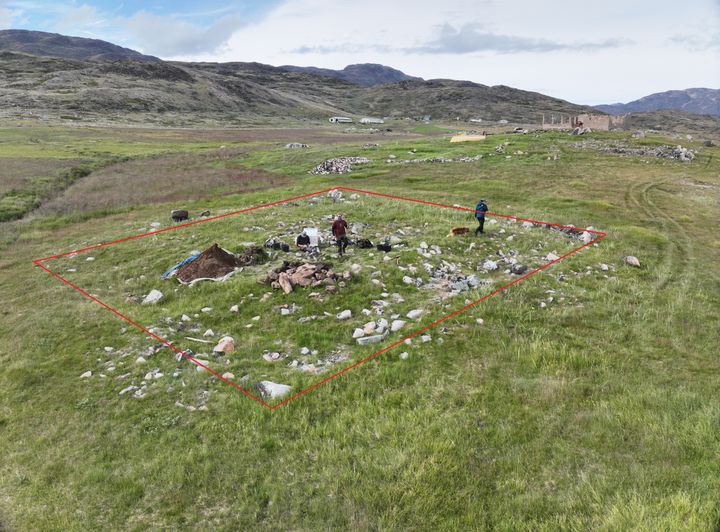
The red line marks the cemetery wall. Inside is the church and the cemetery. Graphic: The National Museum of Denmark.
This is not a story about Viking-Age pagan worship. The church belongs to the Christian period of Norse Greenland. The larger story is Norse society: who had the power to build, who could maintain a settlement, and what happened when that society eventually collapsed and disappeared from Greenland around the 1400s.
In the relatively small area around Brattahlíð, six churches have now been identified. Only three remained in use into the Middle Ages.
“It almost seems as if this area was home to a veritable race to build churches and thus demonstrate power and position,” Madsen said. “That race likely had some losers who perhaps gave up on their church buildings, such as this one. More research will show.”
That is a useful warning against flattening all Norse history into axes, ravens, and dramatic weather. Churches were political buildings. They were religious buildings. They were statements in stone. The grave gives the researchers the proof they needed, but the real question is what this site says about hierarchy, settlement, and the struggle to remain rooted in a harsh place.
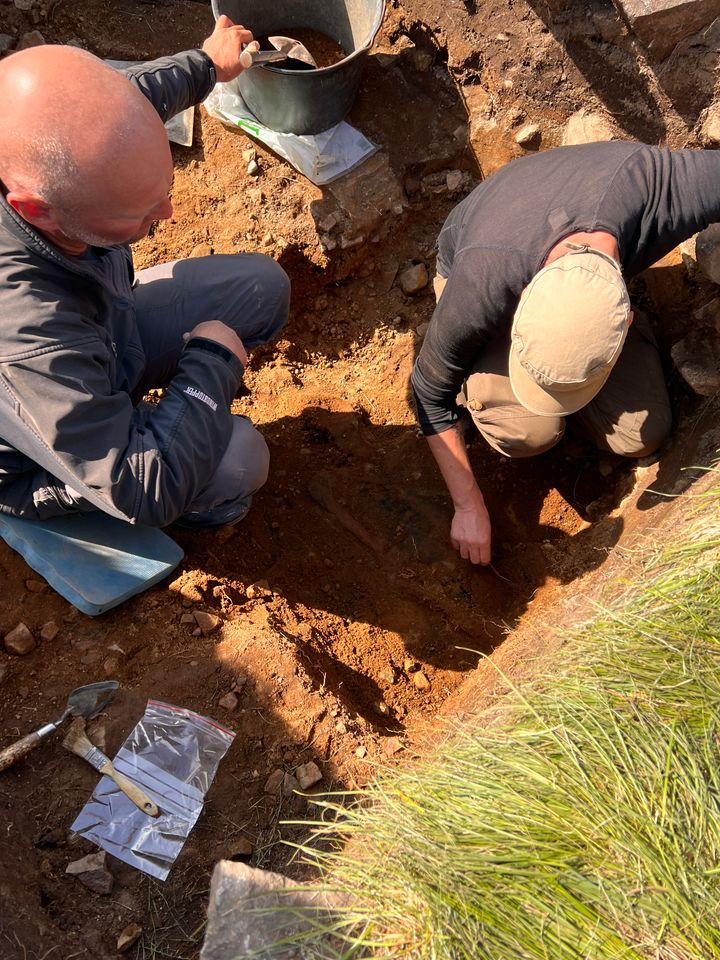
The skeleton during excavation at Qinngua. Photo: Michael Nielsen, Greenland National Museum and Archives.
COMMUNITY DESK: QUEER WITCHES MAKE THEIR OWN ROOM IN ST. LOUIS
The first Witches’ Moot is taking place this weekend, September 26–27, at Tower Grove Pride in Tower Grove Park, St. Louis.
Organizer Stephanie Deirdre, who describes herself as “a flexible lesbian and a lazy Witch”, put the event together in about two months. The idea grew out of disappointment with how the St. Louis Pagan Picnic handled a disruption by white supremacists at the 2025 gathering. Deirdre went to Tower Grove Pride looking for advice. Instead, the organizers offered her space.
The Moot includes:
- “Queering Divination: Reading Beyond the Binary”
- “Uprooting Hate in Heathenry”
- “Herbs of Our Ancestors,” led by Camino Cempasuchil, a Curanderismo practitioner focused on end-of-life care
- “Solomonic Pentacles for the Discerning Queer Revolutionary”
Co-organizer Zoe, a bisexual trans woman and Wiccan practitioner, pointed to the history of queer people in modern Witchcraft. “I think today we take the intersection of Queer folk and magick for granted today,” she said, “when many of our Queer magickal ancestors like Eddie Buczynski were ostracized from traditional Wiccan circles due to their sexuality.”
Deirdre stresses that the Moot is not competing with the Pagan Picnic. It is simply meant to be a more queer-centered space. A different room in the same battered old house.
The event arrives after the loss of St. Louis’s Pagan Pride gathering and continued frustration around the Pagan Picnic. Zoe put the message bluntly: “We are still here, we are still queer, and we are still going to rule the world.”
That is not a bad thing to say while setting up folding tables.
Cherry Hill Seminary ordains four
Cherry Hill Seminary held its fall ordination service on September 19 for four graduates:
- Timothy Billbrough, CMC
- Brenda Ann Cole, Certified Spiritual Director
- Karen Bilan “Bee” Gomez, CMC
- Lisa Lake, CMC, Certified Spiritual Director
A clergy review committee interviewed and evaluated each candidate. The committee included Rev. Wes Isley, HPs Carol Kirk, Rev. Karen LeBlanc, Rev. Cedar Monroe, and Dr. Robert Patrick. The seminary also contracted an outside firm for background checks.
Rev. Cedar Monroe conducted the ceremony and described ordination as both the culmination of ministry training and the beginning of ministry itself. Seminary director Holli Emore said, “The choice to seek ordination shows a willingness to cross a threshold into the next stage of their life path.”
Cherry Hill is not tradition-specific. Its work includes ethics, personal theology, ritual development, spiritual care, and leadership in Pagan and Nature-Based spiritualities.
AI and Paganism survey remains open
Author Yvonne Aburrow is conducting an anonymous online survey about artificial intelligence and Paganism. The survey follows an earlier call for contributions to an anthology gathering Pagan, Heathen, polytheist, and animist responses to generative AI.
The survey is available here: https://forms.gle/U58AykemajoJRvU78.
Lehigh Valley Pagan Pride Day disrupted
Lehigh Valley Pagan Pride Day, held September 12 in Easton, Pennsylvania, was disrupted twice by Christian protesters who told attendees, including children, that they were going to Hell and needed to repent.
Security escorted the first protester out. That person returned with two others, including one using a headset and microphone. Security moved the group to the parking area, and police were called. Officers removed all three. No physical violence was reported.
The event included Robert L. Schreiwer, founder of the Urglaawe tradition; Joe GhostFox LeVasseur of Green Mountain Druidry Order; representatives of the Covenant of the Goddess; a prison ministry session with Rev. Jamie Dana; and a Mabon ritual led by the Coven of the Wooded Vale and the Order of Esoteric Knowledge. Organizers also collected food donations for Second Harvest Food Bank.
The organizers called the gathering a success and thanked the community: “Once again we are humbled and awed by the actions of our community.”
Culture note: the witchiest autumn yet?
Condé Nast Traveller has declared 2026 “the witchiest” autumn yet, pointing to Practical Magic 2, Disney’s November release Hexed, roughly nine million #WitchTok posts, Cornwall’s Witch Festival, a new Witchfest Market in Lewes, Charlotte Church’s sold-out Witchcraft retreats at The Dreaming, and the Witch’s Cottage in Los Angeles.
Meanwhile, conservative Christian outlets have objected to positive portrayals of Witchcraft in Practical Magic 2 and Disney’s Coven Academy. Their complaint, as reported by The Wild Hunt, is largely that these stories present Witchcraft as friendship, belonging, confidence, and heroic power.
Both things can be true: fictional witches are having a mainstream moment, and actual Pagan, Witch, Heathen, and polytheist communities still deal with harassment, discrimination, and legal uncertainty. A movie is not a religious-rights case. A streaming series is not a coven. Keep the categories straight.
ARCHAEOLOGY DESK: SILVER, SPINDLES, AND A SERPENT TALISMAN
Sweden’s Hoerningsholm hoard bought by the state

The Hoerningsholm hoard. Photo: Richard Groenwall (CC BY).
A woman digging for fishing bait near her summer house on Mörkö, near Södertälje, Sweden, discovered the Hoerningsholm hoard in August 2025.
The find contains approximately 24,100 silver coins and 144 other objects, weighing about 4.7 kilograms. It is being described as the largest coin hoard ever found in Sweden.
Most coins date to the twelfth century. Some carry the inscription KANUTUS, associated with King Knut Eriksson. The hoard also includes an unusually large number of rare “bishop coins” and coins connected with Gotland.
In May 2026, Sweden’s National Heritage Board, Riksantikvarieämbetet, decided to redeem the hoard for 4 million Swedish kronor. The finder reported the discovery promptly and met her legal obligations.
Overantikvarie Magnus Larsson said a redemption payment must be reasonable: it should not disadvantage the finder, but it also should not be so high that it encourages treasure looting.
That is the line public archaeology keeps walking. Reward discovery, protect heritage, and do not turn every field into a hunting ground for people with metal detectors and more enthusiasm than paperwork.
Also, “Viking treasure” is too blunt here. The material spans the Viking Age into the early medieval period, and much of it dates to the twelfth century. History is rarely kind enough to fit the headline.
A goddess called “the Lady” in Cova Dones
At Cova Dones in Millares, Valencia, Spain, the 2026 campaign documented at least 120 Latin inscriptions, most dating to the first and second centuries CE. The inscriptions were found more than 200 metres inside the cave, in what researchers identify as a Roman sanctuary.
That makes Cova Dones the largest known collection of Latin inscriptions in a cave sanctuary anywhere in the former Roman Empire, at least provisionally, pending further study.
Five votive inscriptions are dedicated to a goddess called Domina, meaning “the Lady.” The title is the feminine form of dominus and carries real authority, not merely polite address. Three inscriptions include the word MALACI, a previously unknown epithet that may be connected with water.
Female names appear in the inscriptions. Researchers also found many spindle whorls, or spinning weights, suggesting that women participated actively in the cult and may have offered spindles.
Other finds include two bronze rings, a bracelet, chalice-shaped vessels, ceramic fragments, animal remains, and a Roman coin of Emperor Claudius found in 2024.
“Thanks to a quintet of votive inscriptions, we know for certain that in Roman times a goddess was worshipped in the cave whom they reverentially called Domina, ‘the Lady,’ and that women actively participated in her cult,” said Silvia Alfaye, professor of Ancient History at the University of Zaragoza.
Sergio Garcia-Dils of UNED-Sevilla described the evidence as a specific cult to a particular deity rather than random visits. The concentration of inscriptions in one deep, defined area points toward organized ritual activity.
The cave also contains more than 100 Palaeolithic paintings and engravings, some over 24,000 years old. The project, DONARQ, is led by Virginia Barciela of the University of Alicante and Aitor Ruiz-Redondo of the University of Zaragoza.
Staraya Russa pendant carries two religious worlds
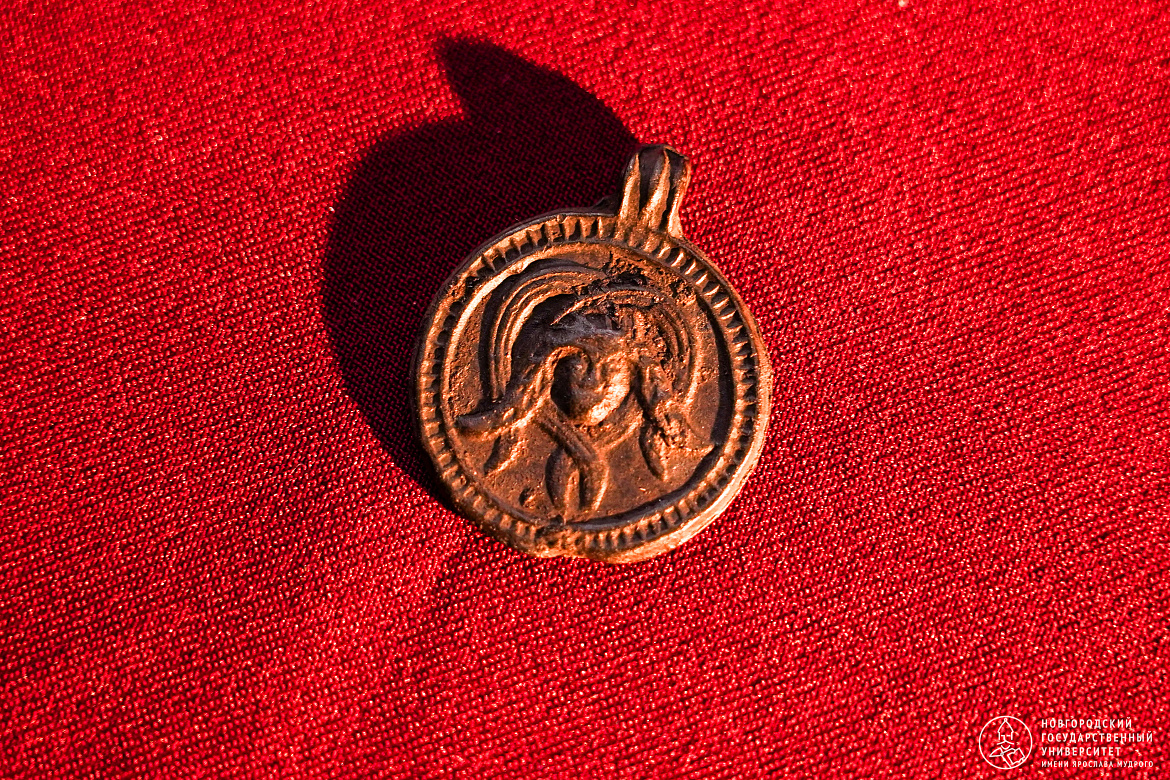
The serpent-pendant, or zmeevik, from Staraya Russa, 11th century. Image courtesy of Novgorod State University.
Researchers from Novgorod State University found an eleventh-century double-sided serpent pendant, or zmeevik, at the Pyatnitsky excavation site in Staraya Russa, northwestern Russia.
One face shows a warrior saint with spear and shield, tentatively identified as Saint Theodore Stratelates. The reverse shows a woman’s head with snake-like hair, recalling the Gorgon or Medusa tradition. Researchers do not identify the figure as Medusa. They describe it more cautiously as a generalized image of dark or threatening forces.
The pendant pushes local evidence for this tradition back at least a century. Previously, only four similar pendants were known from Staraya Russa, dating from the twelfth to fourteenth centuries. Some serpent pendants carry Greek incantations and were worn as protective talismans against illness.
“The main characteristic of the serpentine pendant is its combination of images that are incompatible, from a strictly dogmatic standpoint,” said Sergei Toropov, director of the Novgorod State University Center for Archaeological Research.
That combination is the point. Older protective imagery did not simply vanish when a newer religious system arrived. It was absorbed, reworked, and worn against the body. Old signs do not always die. Sometimes they get a new job.
LEGAL & CIVIC DESK: RELIGIOUS FREEDOM ON PAPER, IN COURT, AND BEHIND BARS
California’s AB 1881 remains unsigned
California’s AB 1881, the California Indian Freedom Act of 2026, passed both chambers and went to Governor Gavin Newsom. As of this issue, Newsom had not signed or vetoed the bill; the deadline was September 30.
Introduced by Assemblymember James C. Ramos, the bill would take effect January 1, 2028. It would prohibit state agencies from substantially burdening Native American religious beliefs or spiritual practices on state lands unless the state demonstrates a compelling interest using the least restrictive means.
The measure would require free, prior, and informed consent from affected tribes when a project could:
- Destroy or substantially alter a sacred site
- Restrict access or privacy
- Cause long-term environmental degradation affecting spiritual practice
It also addresses access to sacred sites and ceremonial grounds, gathering traditional foods and plants, and possession of regalia, eagle feathers, medicines, and ceremonial instruments. Information identifying sacred sites would remain confidential and exempt from public-records law.
The current version applies to state lands, not city and county lands. It includes public-safety exceptions and exempts the State Water Resources Control Board.
Opponents, including the California Chamber of Commerce, water agencies, and local governments, argue the consent requirement could give tribes substantial influence over infrastructure and water projects. Morning Star Gali of the Pit River Tribe and Indigenous Justice has said the goal is meaningful consultation, not another procedural box to tick.
This is not a Pagan law. It concerns Native American religious freedom and tribal sovereignty. But the strict-scrutiny standard is similar to the protection Pagan groups have spent decades asking courts to apply to minority faiths. California is also home to many American Pagan organizations, and what happens on state land can matter when Heathen, Pagan, and polytheist groups seek space for ceremony.
On September 25, Native American Day, Newsom signed a separate package of tribal legislation, including AB 1841, making Native American Day a paid state holiday; AB 2115, issuing a formal legislative and judicial apology; and AB 2507, making the Governor’s Office of Tribal Affairs permanent. AB 1881 was not included in that package.
Maine court weighs parental religion against child welfare
In Emily A. Bickford v. Matthew A. Bradeen, decided September 1, the Maine Supreme Judicial Court unanimously affirmed an order giving the father final decision-making authority over aspects of his thirteen-year-old daughter’s religious upbringing and medical care.
The court held that courts may use the ordinary best-interest-of-the-child standard in disputes between parents over a child’s religious upbringing. They do not have to apply strict constitutional scrutiny first.
The mother became a Christian and began taking the child to Calvary Chapel Greater Portland in 2021. The child later experienced anxiety and panic attacks connected to teachings about Hell and the Second Coming, including fear that her father would not be saved.
The trial court did not find harm in a belief system “rooted in the Bible” as such. It focused instead on the child’s distress, conflict between the parents, and messages portraying the father as an enemy or persecutor of the child’s faith.
The high court emphasized that both parents hold constitutional interests. It distinguished a custody dispute between competing parents from a government restriction on a parent’s religious practice. It also stated that courts may not favor one parent because of religion or show hostility toward a faith.
Liberty Counsel, which represented the mother, says it plans to petition the U.S. Supreme Court. Founder Mat Staver said the decision “rejects the First Amendment right of a fit parent to raise her child consistent with her Christian faith.”
This is not a Pagan case. Its possible effect is broader: the standard could apply when separated parents disagree over a child’s participation in Pagan ritual, observances, initiation, or religious education.
Other cases to watch
The U.S. Supreme Court is scheduled to hear Grand v. City of University Heights on December 9, 2026. The case concerns whether a resident may challenge zoning restrictions on home prayer gatherings before completing the local permit process. It does not involve Pagans, but the framework could affect covens and home worship. No decision is expected before 2027.
In Deyette v. Oregon Department of Corrections, No. 6:24-cv-01015, decided September 4, a federal district court denied both sides’ motions for summary judgment on a Religious Land Use and Institutionalized Persons Act claim involving a prison ban on religious books.
The court found that the plaintiff met the initial burden of showing a substantial burden on religious exercise. Genuine disputes of material fact remain over whether the book ban is the least restrictive means of serving a compelling institutional-security interest.
The texts at issue were Satanic religious texts, not Pagan ones. The case belongs here because its reasoning concerns minority-faith access to religious materials inside institutions: the same general legal framework that affects Pagan prisoners seeking books, medallions, altar cloths, and ritual items.
EVENTS DESK, NORTH AMERICA
Confirm dates, locations, admission, lodging, accessibility, and other details with organizers before travel. Events change. Calendars get mangled. Do not blame the raven.
- Tower Grove Pride Witches’ Moot: St. Louis, Missouri, September 26–27.
- California Native American Day, September 25. A state holiday once AB 1841 takes effect.
- Ardantane: “For the Love of Books”, Online, Saturday, October 17, 10 a.m.–about 4:30 p.m. Mountain Time. Workshops on Seshat, ancient scribes, Enheduanna, manuscript illumination, Books of Shadows, library care, writing, publishing, and fighting book bans. Admission is $15. Registration closes at 5 p.m. Mountain Time on Friday, October 16.
- EarthSpirit Twilight Covening: October 9–12, Berkshires, western Massachusetts.
- EBSAT monthly meeting: Online, Monday, October 12, 8 p.m. Eastern. Zoom link. Meeting ID: 890 3027 2698. Passcode: CCL.
- EarthSpirit Ancestor Ritual and Sacred Land Walk: October 25, 1–5 p.m., Glenwood, western Massachusetts.
- EarthSpirit Samhain Ritual, Friday, October 30, 7:30–9 p.m., Williamsburg Grange, Williamsburg, Massachusetts.
- EarthSpirit Yule: December 19, Williamsburg, Massachusetts.
- Oak Spirit Sanctuary Samhain, October 23–25.
- Circle Sanctuary Samhain Festival: Barneveld, Wisconsin, October 30–November 1, with rituals, workshops, and a cemetery procession.
- Samhainfest 2026: October 31–November 1, Harmer’s Town Art Center, Havre de Grace, Maryland. Workshops, marketplace, and silent Dumb Supper.
- Hekate’s Sickle Festival: November 6–8, Camp Moran State Park, Orcas Island, Washington. A three-day ATC Witch retreat devoted to Isis, Hekatean practice, sacred arts, and community ritual. Registration is $299 for the all-inclusive weekend. Space is limited. Cabins are rustic and not ADA-compliant; organizers point attendees toward off-site lodging at Doe Bay Resort, about 12 miles away, and Rosario Resort, about 9 miles away. Festival information.
- Coreopsis Journal: “Spellbound” anthology submissions, Open worldwide until December 1 at 11:59 p.m. Eastern. Fiction up to 15,000 words and poetry up to 50 lines. Token payment. Priority reading is available for Ukrainian and Ukrainian-diaspora writers.
SYMBOLS & CONTEXT: HAMMERS, KNOTS, AND THE PROBLEM OF ASSUMPTION
Mjolnir, the Valknut, runes, and related Norse symbols have long religious, cultural, linguistic, and historical lives. Some extremist movements have also appropriated them.
That distinction matters.
The Anti-Defamation League documents extremist appropriation of Thor’s Hammer and the Valknut, while also cautioning that these symbols are used by non-racist Heathens, Pagans, historians, and cultural groups.
A few practical points:
- Mjolnir has a long history as a symbol connected with Thor and modern Heathen religious practice. Its appearance alone does not identify someone as extremist.
- The Valknut is an archaeological symbol with disputed interpretation and modern religious use. Context is essential.
- Othala has documented neo-Nazi use, especially in altered or winged forms, but it also has older historical and contemporary religious uses.
- Tiwaz and Sowilo have legitimate runic and religious histories, while some rune forms have been adopted by extremist groups.
- Armanen runes are a separate modern rune system with genuinely documented neo-Nazi associations. They should not be casually treated as interchangeable with the historical Elder Futhark.
Use a context checklist:
- Is the symbol appearing in an ordinary religious, cultural, historical, or educational setting?
- Is it paired with explicit extremist imagery, slogans, or statements?
- Is there a documented organizational affiliation?
- What does the person or group actually say and do?
This article is not identifying any person or group as extremist for displaying a symbol. Ordinary religious and cultural use should not be treated as proof of extremism. At the same time, documented extremist behavior should be named plainly when the evidence supports it.
A hammer is not a confession. Neither is a knot.
SHORT EDITORIAL: WHAT PEOPLE CARRY
This week gave us a church nobody remembered building, a cave where women left spinning weights for a goddess whose name is gone, a record pile of medieval silver bought back by the state, and a Pride festival in St. Louis where queer witches built their own room.
Institutions rise. Denominations fade. Buildings become walls, then stones, then photographs in an archaeology report. Names disappear. The small human practices keep going anyway because people carry them.
A spindle. A burial posture. A pendant worn against illness. A book kept in a prison cell. A ritual held in a park after somebody tried to frighten the community out of showing up.
That is the part worth watching.
Check the sources. Confirm the event details. Know whether a story is about Pagan religion, Norse Christianity, archaeology, or somebody else’s legal fight. Keep your judgment sharper than your spear, and keep building the rooms your people need.
SOURCES & CITATIONS
- National Museum of Denmark: Norse church ruin found in Greenland
- The Wild Hunt: Pagan Community Notes, Week of September 24, 2026
- The Wild Hunt: Pagan Community Notes, Week of September 17, 2026
- The Wild Hunt: Pagan Pride Celebration Continues After Protesters Disrupt Lehigh Valley Pagan Pride Day
- The Wild Hunt: Two Faces of Faith, 11th-Century Amulet with Medusa-Like Image
- The Wild Hunt: The Lady in the Cave. Archaeologists Reveal a Sanctuary to an Unknown Goddess
- The Wild Hunt: Maine High Court Weighs Religious Freedom Against Child’s Best Interests
- The Wild Hunt: California Lawmakers Approve New Religious Freedom Protections for Native Tribes
- Governor Newsom Signs Legislation Supporting California Native Americans
- California Legislative Information: AB 1881
- University of Alicante: Latin inscriptions discovered at Cova Dones
- Swedish National Heritage Board: Hoerningsholm hoard redemption decision
- Svensk Historia: Hoerningsholm hoard redeemed for 4 million kronor
- Deyette v. Oregon Department of Corrections
- SCOTUSblog: Grand v. City of University Heights
- Circle Sanctuary: Samhain
- Samhainfest
- Oak Spirit Sanctuary: Samhain at the Sanctuary
- EarthSpirit: Sacred Land and Events
- Hekate’s Sickle Festival
- Anti-Defamation League: Thor’s Hammer
- Anti-Defamation League: Valknut