

Raven's Dispatch: The Bronze Age Beneath the Ship & The Pagan in the Federal Record
SUNDAY, AUGUST 23, 2026 : NORTH AMERICAN DESK
Modern life is loud, fast, and strangely forgetful. We carry entire libraries in our pockets, then lose track of what we read five minutes ago. Governments build databases meant to recognize everybody, yet somehow leave whole communities out of the menu. We flatten old places, rename old practices, and act surprised when the buried things turn up again.
This week, two stories put that problem in plain view.
In Norway, archaeologists found that a Viking ship mound had been built over an older Bronze Age burial. In Washington, a Pagan organization placed its own policy analysis into the federal record during a national debate over religious liberty.
Stone beneath soil. A name inside a ballot system. Different worlds, perhaps. Not really.
Both stories ask the same hard question: what survives when later powers build on top of what came before?
ARCHAEOLOGY: The Viking Mound Was Already Ancient
Beneath the ship burial, an older sacred place waited
Archaeologists from the University of Stavanger have reopened the Grønhaug burial mound on Karmøy, Norway : a site first excavated in 1902.
The new trench has produced iron rivets from the Viking ship and a layer of birch bark that may have served as flooring or part of the burial construction. Dating work places the mound at roughly A.D. 864, during the early Viking Age.
That alone would be a respectable find. The old ship, the iron, the timber, the burial mound : the usual roll call of northern power and ritual.
But the real story was lower down.
The team reached the ground surface beneath the Viking mound and found preserved organic material nearly 1,200 years old. Blueberry plants. Heather. Leaves still attached.
Archaeologist Marie Ødegaard described the discovery this way:
“The burial was so well preserved that I could see blueberry plants and heather that were growing there when they built the mound in the Viking Age. The plants even still had leaves on them.”
That is the sort of detail that cuts through the academic fog. Somebody stood on that ground nearly twelve centuries ago. The plants were growing. Then the builders covered the place, layer by layer, and raised a ship burial above it.
And beneath the vegetation, they found something older still: a stone cairn surrounded by a ring of stones, likely the remains of a Bronze Age burial.
The Viking mound was not simply placed on an empty patch of land. It appears to have been deliberately built over a much older funerary or sacred site.
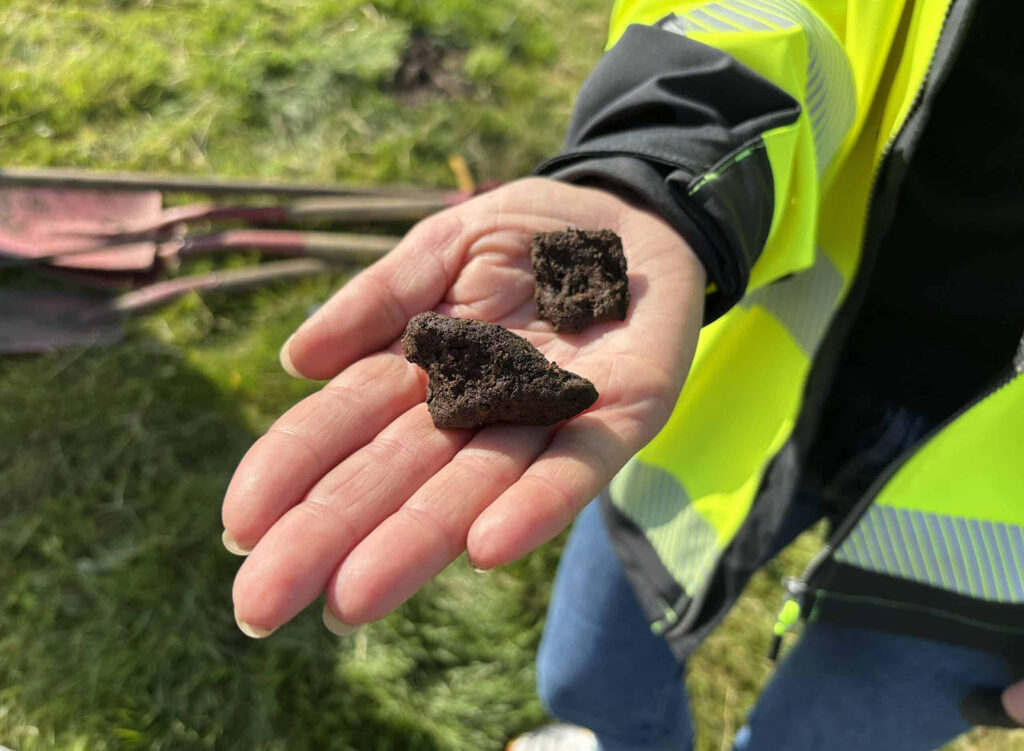
Iron nails from the Grønhaug ship burial. Credit: Jan Magnus Weiberg-Aurdal.
The dead were not forgotten : they were claimed
We should be careful here. Archaeologists can identify construction, material, dating, and patterns. They cannot always recover the exact thoughts of the people who made those choices.
Still, building a monumental Viking burial over an earlier cairn was probably not random.
Across northern Europe, burial mounds were part of a living landscape of memory. They marked territory, connected families to ancestors, and gave political authority a deep root. A ruler or elite person buried over an older grave could be claiming continuity : not just land, but legitimacy.
The message may have been something like this: our dead belong here because the old dead were already here.
That is how power often works. It does not always erase the past. Sometimes it places itself directly on top of it.
The Grønhaug excavation also gives us something more personal than a theory of kingship. The blueberry leaves and heather make the burial feel physical. You can almost smell the wet earth and crushed green stems. The past was not made of gray museum glass. It was soil, bark, iron, grass, and cold coastal wind.
We tend to picture the Viking Age as a saga carved in steel. In reality, it was also a field somebody walked through before the mound was raised. That older landscape remains part of the story.
FAROE ISLANDS: A Runestone Under a Christian Floor
“Here rests” may mark a lost grave
At Á Sondum on Sandoy in the Faroe Islands, archaeologists found a runestone embedded in the floor of a medieval prayer house.
Only a small number of runestones are known from the Faroe Islands, making the discovery significant before the inscription is even fully understood. A preliminary reading appears to include the Old Norse phrase “Her hvílur” : “Here lies” or “Here rests.”
That wording strongly suggests a burial marker or memorial stone.
The stone had been reused as a floor slab, its earlier purpose hidden beneath feet, furniture, dirt, and centuries of religious change. Other finds at the site include fragments of a small Virgin Mary sculpture and a kola, a small oil lamp. The building has been dated to around A.D. 1000, a period when Norse pagan traditions and Christianity were meeting, competing, adapting, and sometimes occupying the same physical spaces.
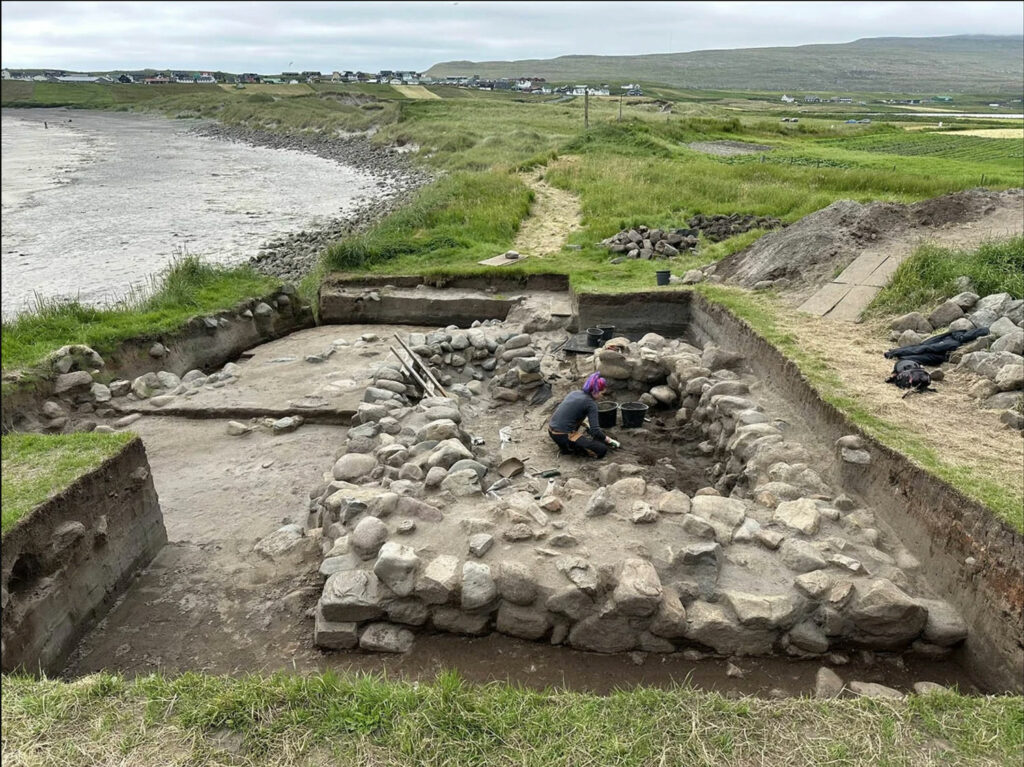
Excavation at Á Sondum, Sandoy. Credit: Helgi Michelsen.
The runestone does not offer a neat conversion story. History rarely does. A stone bearing a likely funerary inscription may have been placed in a Christian building because its original memorial context was no longer understood, or because the stone was simply useful. It may have been respected, repurposed, or both.
That is the rough edge of religious history. Traditions do not always replace one another cleanly. They overlap. They borrow. They build chapels where older people buried their dead, and they set old stones into new floors.
Someone had to crouch beside that stone with a flashlight to see the runes clearly. That image says plenty. What was once public memory had become nearly invisible.
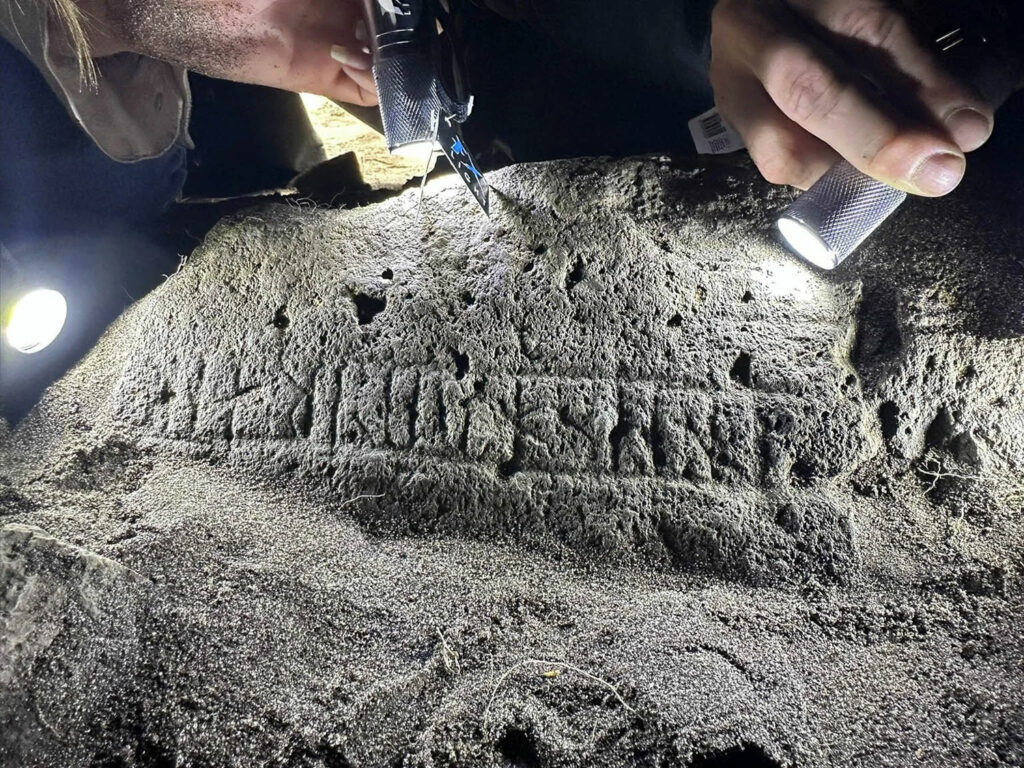
The Á Sondum runestone under flashlight. Credit: Helgi Michelsen.
PAGAN RIGHTS & THE FEDERAL RECORD
Religious liberty is tested at the edges
The Pagan Solidarity Alliance submitted Policy Brief No. 2026-01 during the Presidential Religious Liberty Commission’s public-comment period. The submission entered the federal record under DOJ-RLC Comment-009205, including the transmittal email, cover letter, and full brief.
The argument is broader than Paganism. PSA says religious liberty is tested when government encounters communities that are small, unfamiliar, or imperfectly understood.
That is exactly where the machinery tends to grind.
A form has no suitable category. A military database reduces more than 200 faith and belief codes to 31. An accommodation process assumes every religion has a central authority, a weekly service, or a familiar name. None of these decisions need to arrive with a villain twirling a mustache. Administrative invisibility can do the job quietly.
The Commission held a virtual public meeting on August 17 to review comments and finalize its report. During the comment process, Pagans were often missing from lists of minority religions. Muslims, Sikhs, Hindus, Buddhists, Jews, Baha’is, Indigenous traditions, Humanists, and atheists were named : all deserving inclusion : while Pagans, Wiccans, Druids, Heathens, and modern polytheists were frequently forgotten.
That omission matters. If the government cannot remember a community exists, it will struggle to write rules that work for its members.
PSA has also filed Freedom of Information Act requests concerning the Department of Defense faith-code reduction. The goal is straightforward: find out how the change was made, what evidence supported it, and how minority-faith service members are expected to navigate the new system.
The pagan voice is now in the record. That is not the finish line. It is the first stone in the road.
North Carolina ballot dispute puts a religious name on the line
In North Carolina, Wiccan candidate Mortellus has petitioned the State Board of Elections to allow their religious mononym to appear on the November ballot in their campaign for supervisor of the Rutherford Soil and Water Conservation District.
The Board is considering whether a candidate may use a religious name without adding a surname. The case could establish an important precedent for religious names and ballot access.
Mortellus said:
“People from Pagan and other minority-faith communities need to know that we can step into civic life without surrendering parts of ourselves at the door.”
The dispute is procedural on its face : registration records, filing rules, ballot formatting. Those details matter, but so does the larger question. Public participation should not require a person to strip away the name by which their religious community knows them.
The State Board scheduled its final consideration for August 20. Whatever decision follows, the case has already made one point visible: Pagans are not only asking to be left alone. They are seeking office, serving communities, and entering the same civic machinery as everyone else.
That is what religious liberty looks like when it leaves the courthouse and walks into a county election.
COMMUNITY NEWS & EVENTS : NORTH AMERICA
Recent and upcoming community notices include:
- Love of Community: Norse & Celtic : an educational program hosted by the Interfaith Alliance of Colorado on August 14 during Interfaith Awareness Week.
- Freyfaxi at Freyshof : held August 15 by the Asatru Folk Assembly, with recognition of King Radbod of Frisia.
- Haugaland Hof Fall Men’s Retreat : September 11–14, Ohio.
- Mystic Mabon Southwest : September 17–20, Tijeras, New Mexico.
- KornuKopia Gathering : September 18–20, Eganville, Ontario.
- White Mountain Druids Autumn Equinox : September 19, Trout Lake, Washington.
- AlThing 46 : September 23–27, near Payson, Arizona.
- Folkish Summer Hallowing : September 24–27, Wayne County, Pennsylvania.
- Mabon & Tribal Gathering at Gaea Retreat Center : September 25–27.
- Mabon & Full Moon Ritual : September 26, Joliet, Illinois.
Event details can shift : because apparently even the gods have scheduling problems : so confirm registration, travel information, and venue rules directly with organizers before setting out.
THE LAST WORD
The Grønhaug mound tells us that later generations often build on older sacred ground. The Faroe runestone shows how a memorial can disappear beneath a new religious structure and still speak when somebody takes the time to look.
The federal record offers the modern version.
A community that wants to be recognized has to place its name where power can find it : in public comments, election filings, meeting rooms, databases, and local gatherings. That work is not glamorous. It is often slow, administrative, and about as exciting as watching paint dry on a courthouse wall.
Do it anyway.
The old stones are still speaking. The question is whether we are willing to put our own names beside them.
SOURCES & CITATIONS
- Archaeology Magazine: Possible Bronze Age Grave Discovered Beneath Viking Ship Burial
- ScienceNorway: Archaeologists opened a Viking burial mound. Beneath it was an even older grave
- Archaeology Magazine: Mysterious Runestone Found in Floor of Faroe Islands Chapel
- The Wild Hunt: Letters to the Editor: When Washington Talks About Religious Liberty, Does It Remember Pagans?
- The Wild Hunt: Pagan Community Notes, Week of August 13, 2026
- Raleigh News & Observer: Wiccan candidate's religious name could appear on NC ballot
- Interfaith Alliance of Colorado: Love of Community: Norse & Celtic
- Mystic Mabon Southwest: About the Festival